Going out to dinner... brief thought:
1000 point jump in 2 days? With a plethora of bad economic news still on the way? Give me a break. Now is the time to short the market. My instincts tell me it's going down.
Monday, November 24, 2008

Wednesday, November 19, 2008
Oil at $40?
Yet another predictive story by the FT . National oil companies expect oil to fall to $40/barrel. Personally I don't think they will go that low, although it's certainly a possibility. This prediction reminds me of the summer, when Goldman Sachs predicted $200/barrel oil and OPEC gave even higher forecasts.
Sunday, November 16, 2008
Deflation and Stock Market Valuation
Here's an interesting article about the spectre of deflation which bond markets are anticipating (inflation-indexed bonds are priced with the assumption that there will be deflation over the next 5 years).
In 2003, as the article points out, there was a deflation scare which caused the Fed to cut interest rates down to 1% and helped fuel the housing bubble. To paraphrase one banker who posted on an investing forum, "Under normal conditions, you go to work at 9 am and cautiously lend money until 5 pm. In 2003, all the 'good' loans for the day were made by 12 pm. This left everyone 5 hours to have a party and make crappy loans (and huge profits) with really cheap money."
30-year treasuries are now yielding a mere 4.4%. Short sale opportunity anyone? The only problem is proper timing. I KNOW they are overvalued, perhaps drastically so because most investors are afraid. This is irrationality in action. The only question is, WHEN will confidence return to the bond markets (so that yields can rise again and you can make money on a short sale)? And will the return of confidence be gradual or sudden?
Also, I am grappling with the question of whether the stock market is currently 'undervalued' or whether it is now finally returning to fair value after a decade of decadent capital gains. I have seen blog posts and heard people say both. I suppose it depends on the way you compute P/E. This article answers the question rather nicely. As does the graph below, showing cyclical P/E ratios just returning to average after years of overvaluation. Cyclical P/E ratios are computed using the price of the stock over the average of the earnings over the last 10 years.
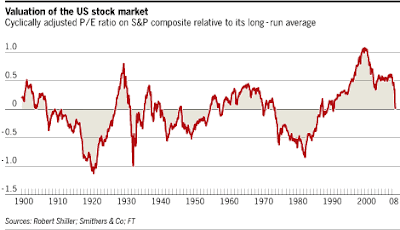
As the article says however, "The news has to come with the caveat that markets are prone to overshoot and become too cheap after prolonged periods when they have been too expensive. Hence, both these measures are consistent with stocks falling much lower before they find a bottom, even though they are currently fairly priced."
Will the market fall ever further after the recent boom period? If one believes that economies which experience a tremendous amount of unsustainable activity must compensate by enduring periods of slowdown below potential growth to compensate and that these economic booms and busts are reflected in stock prices (translated in technical terms as the negative serial correlation of real stock market returns) , then it looks like we may still have a long way to fall.
Here is a prescient report by Andrew Smithers written in February 2007. His thinking on economics, finance and market valuation is quite pragmatic and many of his predictions have already come true. He writes:
"The average return over the past 10 to 30 years has been over 8%, compared with 6.9% over the past 135 years. Investors in the US stock market must expect very poor returns over the medium-term, such as the next 5 to 10 years."
Check THIS one out:
"The gap between the valuations given by CAPE and q indicate, at first sight, that financials are much more overvalued than nonfinancials. We check, by an alternative approach to cyclical adjustment, the overvaluation indicated by CAPE. This confirms the estimate of overvaluation. On the other hand, our look at the details of net worth data for non-financials leads us to suspect that these have become increasingly overstated in recent years."
He concludes:
"The US stock market is probably overvalued by around 77%, as indicated by CAPE, and thus needs to fall to around 800 on the S&P 500 index to reach fair value."
Keep in mind, this was written BEFORE THE FINANCIAL CRISIS. The S&P 500 as of today is at 873. Which means there is still quite a way down to go, especially if you take overshooting into account.
In 2003, as the article points out, there was a deflation scare which caused the Fed to cut interest rates down to 1% and helped fuel the housing bubble. To paraphrase one banker who posted on an investing forum, "Under normal conditions, you go to work at 9 am and cautiously lend money until 5 pm. In 2003, all the 'good' loans for the day were made by 12 pm. This left everyone 5 hours to have a party and make crappy loans (and huge profits) with really cheap money."
30-year treasuries are now yielding a mere 4.4%. Short sale opportunity anyone? The only problem is proper timing. I KNOW they are overvalued, perhaps drastically so because most investors are afraid. This is irrationality in action. The only question is, WHEN will confidence return to the bond markets (so that yields can rise again and you can make money on a short sale)? And will the return of confidence be gradual or sudden?
Also, I am grappling with the question of whether the stock market is currently 'undervalued' or whether it is now finally returning to fair value after a decade of decadent capital gains. I have seen blog posts and heard people say both. I suppose it depends on the way you compute P/E. This article answers the question rather nicely. As does the graph below, showing cyclical P/E ratios just returning to average after years of overvaluation. Cyclical P/E ratios are computed using the price of the stock over the average of the earnings over the last 10 years.

As the article says however, "The news has to come with the caveat that markets are prone to overshoot and become too cheap after prolonged periods when they have been too expensive. Hence, both these measures are consistent with stocks falling much lower before they find a bottom, even though they are currently fairly priced."
Will the market fall ever further after the recent boom period? If one believes that economies which experience a tremendous amount of unsustainable activity must compensate by enduring periods of slowdown below potential growth to compensate and that these economic booms and busts are reflected in stock prices (translated in technical terms as the negative serial correlation of real stock market returns) , then it looks like we may still have a long way to fall.
Here is a prescient report by Andrew Smithers written in February 2007. His thinking on economics, finance and market valuation is quite pragmatic and many of his predictions have already come true. He writes:
"The average return over the past 10 to 30 years has been over 8%, compared with 6.9% over the past 135 years. Investors in the US stock market must expect very poor returns over the medium-term, such as the next 5 to 10 years."
Check THIS one out:
"The gap between the valuations given by CAPE and q indicate, at first sight, that financials are much more overvalued than nonfinancials. We check, by an alternative approach to cyclical adjustment, the overvaluation indicated by CAPE. This confirms the estimate of overvaluation. On the other hand, our look at the details of net worth data for non-financials leads us to suspect that these have become increasingly overstated in recent years."
He concludes:
"The US stock market is probably overvalued by around 77%, as indicated by CAPE, and thus needs to fall to around 800 on the S&P 500 index to reach fair value."
Keep in mind, this was written BEFORE THE FINANCIAL CRISIS. The S&P 500 as of today is at 873. Which means there is still quite a way down to go, especially if you take overshooting into account.
Thursday, November 6, 2008
A Goodwill Bubble
I have always been wary of extreme emotion on a group level. It can be fun and exciting in a harmless context like a sports game, but in the arena of national politics it can be deadly, especially without strong institutions.
(I wonder if leaders who enjoy extremely strong support can more easily be hated, and if leaders who merely experience moderate support equivalently experience moderate dislike, in the same way that a high technology stock will gain or lose 40% in a week and a utility company might only fluctuate by 5%.)
I believe that we are currently experiencing a 'bubble' of political goodwill with the election of Obama. Surely he might turn out to be a good (or even great) president, but it is rare that such enthusiasm and adoration from the crowd persists over a long stretch of time. At some point, even the most beloved politicians make one misstep too many and lose their political base. And even if the politican is able to inspire the country (a la FDR) his actual policies may do more harm than good as in FDR's case who attempted to pump-prime the economy in classical Keynesian style by paying men to bury money and then paying them once again to dig it up. As I understand it, unproductive procyclical fiscal policy and a lack of business confidence were two major reasons for the perpetuation of the Great Depression. Undoubtedly fiscal policy only works well when it is conducted productively.
(Note to self: investigate this question some more. What are the quantitative differences between productive and unproductive fiscal policy? What specific policies count as productive or unproductive? Did it really perpetuate the Great Depression? Learn more about the Great Depression's causes. There is so much to learn!)
I digress. I tentatively predict that Obama will enter the White House with a large amount of support, but at some point will slip up and experience a temporary or more likely, permanent decrease in goodwill. Barring assassination, this seems to be the life cycle of most politicians. The less history a politician has, the fewer hard binary choices he's made, the fewer groups he's pissed off, the more people like him. Obama seems to be intelligent and practical; I doubt he would make the recession worse in 2009 by instituting contractionary fiscal policy in the form of much higher taxes or trade restrictions. But if he does, the economic effects could be devastating and his political life cycle would be that much shorter.
(I wonder if leaders who enjoy extremely strong support can more easily be hated, and if leaders who merely experience moderate support equivalently experience moderate dislike, in the same way that a high technology stock will gain or lose 40% in a week and a utility company might only fluctuate by 5%.)
I believe that we are currently experiencing a 'bubble' of political goodwill with the election of Obama. Surely he might turn out to be a good (or even great) president, but it is rare that such enthusiasm and adoration from the crowd persists over a long stretch of time. At some point, even the most beloved politicians make one misstep too many and lose their political base. And even if the politican is able to inspire the country (a la FDR) his actual policies may do more harm than good as in FDR's case who attempted to pump-prime the economy in classical Keynesian style by paying men to bury money and then paying them once again to dig it up. As I understand it, unproductive procyclical fiscal policy and a lack of business confidence were two major reasons for the perpetuation of the Great Depression. Undoubtedly fiscal policy only works well when it is conducted productively.
(Note to self: investigate this question some more. What are the quantitative differences between productive and unproductive fiscal policy? What specific policies count as productive or unproductive? Did it really perpetuate the Great Depression? Learn more about the Great Depression's causes. There is so much to learn!)
I digress. I tentatively predict that Obama will enter the White House with a large amount of support, but at some point will slip up and experience a temporary or more likely, permanent decrease in goodwill. Barring assassination, this seems to be the life cycle of most politicians. The less history a politician has, the fewer hard binary choices he's made, the fewer groups he's pissed off, the more people like him. Obama seems to be intelligent and practical; I doubt he would make the recession worse in 2009 by instituting contractionary fiscal policy in the form of much higher taxes or trade restrictions. But if he does, the economic effects could be devastating and his political life cycle would be that much shorter.
Annoying Cliches
I see these all too often when I read business/political news. They are especially prevalent in online forum discussions and political speeches. They betray a lack of rhetorical skill that may also imply a broader lack of creativity and intellect.
"Shore up the economy"
"Quick study"
"Chickens come home to roost."
"Boots on the ground" - in reference to Iraq/Afghanistan usually
"That's an X, if I've ever seen one."
More to be added.
"Shore up the economy"
"Quick study"
"Chickens come home to roost."
"Boots on the ground" - in reference to Iraq/Afghanistan usually
"That's an X, if I've ever seen one."
More to be added.
Friday, October 31, 2008
Monday, October 27, 2008
Investing Attitude
The general attitude among many asset managers right now is:
There are opportunities right now, but let's hold off, because there may be more among the future.
Mohammed El-Arian:
The focus on investing now is that you want to focus on the opportunities that have tremendous mean reversion potential, since some asset classes may not mean revert for quite a long time. The system has quite literally broken down. The burden of proof is higher than simply looking at a company's P/E ratio and saying 'this looks low historically, let's buy it.'
He predicts there will be some more institutional failures within the next couple months.
There are opportunities right now, but let's hold off, because there may be more among the future.
Mohammed El-Arian:
The focus on investing now is that you want to focus on the opportunities that have tremendous mean reversion potential, since some asset classes may not mean revert for quite a long time. The system has quite literally broken down. The burden of proof is higher than simply looking at a company's P/E ratio and saying 'this looks low historically, let's buy it.'
He predicts there will be some more institutional failures within the next couple months.
Sunday, October 19, 2008
Countervailing Factors to a Deep Recession
Barron's wrote an article (due to be published tomorrow) proclaiming that the recession everybody is anticipating won't be as bad as many in the media think.
Here is the article.
Update this post after reading/thinking about it.
Here is another article in Barron's with the 'con' point of view.
Here is the article.
Update this post after reading/thinking about it.
- The main gist of the article is that decreased oil prices will lead to a spur in consumer spending. The question to ask is: Of the average consumer, what percentage of their consumption is devoted to gas/electric bills/goods whose prices fluctuate heavily due to energy costs? How much MORE money would the average consumer spend on goods, ceterus paribus, given its fall since July from ~$147/barrel to new lows of below $70/barrel?
- The author posits that oil at $80/barrel would induce $170 billion in energy savings over 6 months if it held at that level. Assuming half is spent in Q4 2008 and the other half in Q1 2009, the boost to annual spending would be 3.5% in each period. However the author notes that much of this boost would be counteracted by decreased home values and possible decreased stock prices. Overall, GDP will increase slightly according to the author.
- Here are his official reasons for hope:
- Starting in the current quarter, consumer spending (70% of GDP) is likely to post gains, bolstered by lower energy prices.
- Inventory-to-sales ratios are low. Retailers won't be stuck with a glut of unsold inventory (which would further drag down growth) and may even choose to rebuild inventory next year if the economy grows sufficiently.
- Capital spending was subdued during the recent expansion, leaving no need to work off excess industrial capacity.
- Net exports will increase growth very slightly.
Here is another article in Barron's with the 'con' point of view.
Saturday, October 18, 2008
Parting Words From A Hedge Fund Manager
This made me laugh.
Here is the full letter.
Whether his views are right or wrong, he is at least honest. Then again, he can afford to be. There is definitely something to be said for actually enjoying life rather than trying to egotistically inflate one's self-image through money, women, achievements, etc. If those occur coincidentally with the enjoyment, so be it. But when they become the purpose in and of themselves... a hollowness sets in. At least, that has been my experience.
Here is the full letter.
Whether his views are right or wrong, he is at least honest. Then again, he can afford to be. There is definitely something to be said for actually enjoying life rather than trying to egotistically inflate one's self-image through money, women, achievements, etc. If those occur coincidentally with the enjoyment, so be it. But when they become the purpose in and of themselves... a hollowness sets in. At least, that has been my experience.
Friday, October 17, 2008
Research This
http://www.youtube.com/watch?v=-NSk_ZeAH_I
Interesting speech by Noam Chomsky.
Research:
- What is the history of R&D funding in the US? Is most of the private sector's progress driven by public sector research, as Chomsky posits? I know that productivity is the key driver of economic growth, and productivity is in turn largely driven by scientific research and advancement. Thus, this is a crucial issue to consider when deciding on how big a role the state should play in the economy.
- Another thought I had while watching the speech. What is the relationship between a nation's increased economic wealth and its level of ethics/values/morality? Is morality an economic luxury?
- Learn about Chomsky's propaganda model. Read the manufacture of consent.
Interesting speech by Noam Chomsky.
Research:
- What is the history of R&D funding in the US? Is most of the private sector's progress driven by public sector research, as Chomsky posits? I know that productivity is the key driver of economic growth, and productivity is in turn largely driven by scientific research and advancement. Thus, this is a crucial issue to consider when deciding on how big a role the state should play in the economy.
- Another thought I had while watching the speech. What is the relationship between a nation's increased economic wealth and its level of ethics/values/morality? Is morality an economic luxury?
- Learn about Chomsky's propaganda model. Read the manufacture of consent.
Subscribe to:
Posts (Atom)
